
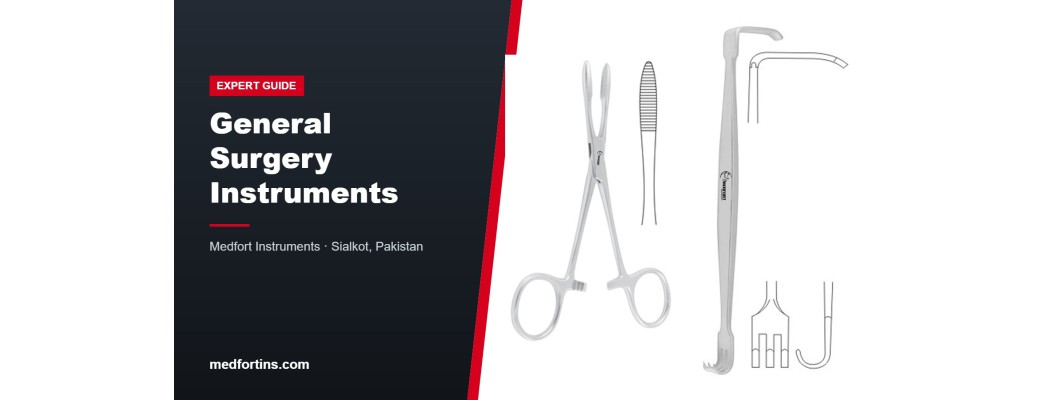
General surgery instruments are the backbone of every operating theatre. Whatever the specialty, most open operations rely on the same core groups: instruments to cut, to hold, to clamp, to suture and to expose. Understanding these groups helps you build sets that are complete without being overloaded. This guide covers each group and what to look for.
Cutting: scissors and scalpels
Scalpel handles hold disposable blades for skin incisions. Scissors do most of the remaining cutting and dissection. Mayo scissors are heavy and cut tough tissue such as fascia; Metzenbaum scissors are lighter, with longer handles, for delicate dissection; and straight operating scissors cut sutures and dressings. Curved blades follow tissue planes, while straight blades make straight cuts. Tungsten carbide (TC) and SuperCut versions stay sharp longer and cut more cleanly.
Holding: tissue and dressing forceps
Dressing forceps have fine serrations and hold dressings and delicate tissue. Tissue forceps have teeth, such as 1x2 rat-tooth patterns, and give a secure hold on skin and tougher tissue. DeBakey atraumatic forceps hold vessels and bowel gently. Grasping forceps such as Allis and Babcock hold tissue for longer periods; Babcock forceps have rounded jaws that are gentle on bowel.
Clamping: haemostatic forceps
Haemostats control bleeding by clamping vessels. They range from fine mosquito forceps for small vessels, through Kelly and Crile, to heavy Kocher and Rochester-Pean clamps for larger tissue pedicles. The ratchet is the critical feature: it must lock firmly at each tooth and release smoothly. Jaws should meet evenly along their whole length.
Suturing: needle holders
Needle holders grip curved suture needles. Mayo-Hegar needle holders are the general-purpose standard. Tungsten carbide jaws grip the needle firmly without twisting and last much longer than plain steel. Match the jaw size to the needle: fine jaws for small needles, heavier jaws for large needles in fascia.
Exposing: retractors
Hand-held retractors such as Langenbeck, Army-Navy, Deaver and Richardson hold tissue back so the surgeon can see. Self-retaining retractors such as Weitlaner, Gelpi and abdominal frame retractors hold the wound open on their own, freeing the assistant. Choose blade depth and width to suit the incision.
Other essentials
- Towel clamps secure drapes around the field.
- Sponge-holding forceps hold swabs for skin preparation and deep swabbing.
- Suction tubes such as Yankauer and Poole keep the field clear.
- Bowel and intestinal clamps hold bowel gently during resection.
- Probes and grooved directors explore sinuses and tracts.
How many of each?
A typical general set has more haemostats than any other instrument, because many vessels are clamped at once. Add enough tissue forceps for the surgeon and assistant, two or three needle holders of different sizes, and a selection of retractors. Your surgeons' preferences matter most, so review set lists with them once a year.
Quality checks
- Ratchets lock at every tooth and release with light pressure.
- Jaws and serrations meet evenly; teeth interlock without gaps.
- Scissors cut cleanly to the tip.
- Joints move smoothly with no side-to-side play.
Care
Rinse instruments immediately after use, open every joint and ratchet for cleaning, use neutral pH detergents, dry thoroughly and lubricate hinges before steam sterilization. Do not store instruments with ratchets closed, as this stresses the joint. Inspect regularly and send scissors for sharpening when they start to catch.
Browse the full range in general surgical instruments, or see ready-made instrument sets.
Talk to Medfort
Medfort Instruments manufactures in Sialkot, Pakistan, and supplies hospitals, clinics, distributors and tender buyers around the world. We make single instruments, bulk orders, complete sets and OEM or private-label ranges with your own laser marking. For prices, samples or a quote, email [email protected] or call / WhatsApp +92 349 0444976.