
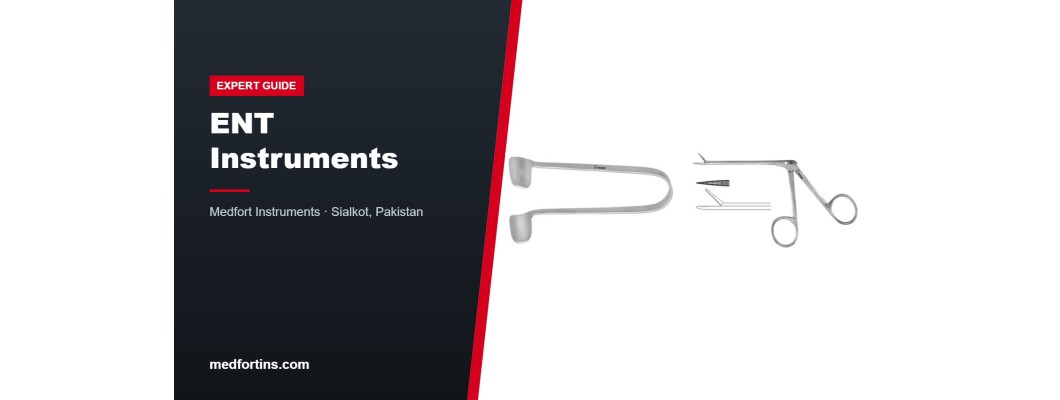
Ear, nose and throat surgery covers a remarkable range of work, from examining an ear in a busy clinic to fine middle-ear surgery under the microscope, septoplasty, sinus surgery and tonsillectomy. Each area has its own instruments, and many of them are long and slim so they can work through narrow openings while the surgeon keeps a clear view. This guide gives an overview of the main ENT instrument groups.
Ear instruments
Ear speculums open the ear canal for examination and minor procedures, and come in several sizes to fit children and adults. Ear hooks, curettes and alligator forceps remove wax and foreign bodies. Ear polypus forceps and snares remove polyps and granulation tissue, and ear syringes are used for irrigation.
For microsurgery of the ear, micro ear knives, curettes, scissors and micro alligator forceps work under the operating microscope. They have long, fine, angled shafts so the surgeon's hand stays out of the line of sight. Mastoid rongeurs remove bone in mastoid surgery.
Nose and sinus instruments
Nasal speculums open the nostril for examination and surgery. For septoplasty and rhinoplasty, surgeons use septum elevators to lift the mucosa, septum chisels, osteotomes and gouges to work on cartilage and bone, rhinoplasty knives for incisions, nasal rasps and bone files to smooth the dorsum, septum straightening forceps, and nasal cutting forceps to remove tissue precisely.
Nasal polypus forceps and snares remove polyps, and nasal tampon forceps and gauze packers place packing at the end of surgery. For sinus work, ethmoid forceps, sphenoidal punches and antrum curettes reach the sinuses.
Throat and tonsil instruments
A tonsillectomy set brings together several groups: mouth gags to hold the mouth open and the tongue down, tonsil dissectors and elevators to separate the tonsil from its bed, tonsil forceps to grasp and hold it, tonsil snares to remove it, and ligators to tie off bleeding vessels. Adenoid curettes remove adenoids. Long, curved tonsil scissors are also part of most sets.
For the larynx and airway, laryngeal forceps and broncho-esophagoscopy forceps work through endoscopes, and tracheal tubes, retractors and dilators are used in tracheostomy.
Choosing ENT instruments
- Length and angle: ENT instruments often come in several lengths and angles. Choose the ones that match your approach and your surgeons' habits.
- Sizes: speculums, curettes and punches come in a range of sizes; children need smaller sizes.
- Fine tips: for micro instruments, check tip alignment under magnification.
- Weight and balance: long instruments should feel balanced, so the surgeon can control the tip without fatigue.
Clinic sets and theatre sets
An ENT outpatient clinic usually needs ear and nasal speculums in several sizes, ear hooks and curettes, alligator forceps, tongue depressors and a light source. Theatre sets are built by procedure: a septoplasty set, a rhinoplasty set, a tonsillectomy set, a tracheostomy set and an ear microsurgery set. Keeping procedure sets separate makes preparation and counting simpler.
Caring for ENT instruments
Many ENT instruments have long, narrow shafts and fine tips that are easy to damage. Clean them immediately after use, paying attention to channels and joints, and use tip protectors on micro instruments. Keep cutting instruments such as chisels, punches and forceps sharp, and inspect them regularly. Store micro instruments separately from heavy instruments.
See the full range in ENT instruments, with more than 30 sub-categories covering ear, nose, throat and maxillofacial surgery.
Talk to Medfort
Medfort Instruments manufactures in Sialkot, Pakistan, and supplies hospitals, clinics, distributors and tender buyers around the world. We make single instruments, bulk orders, complete sets and OEM or private-label ranges with your own laser marking. For prices, samples or a quote, email [email protected] or call / WhatsApp +92 349 0444976.