
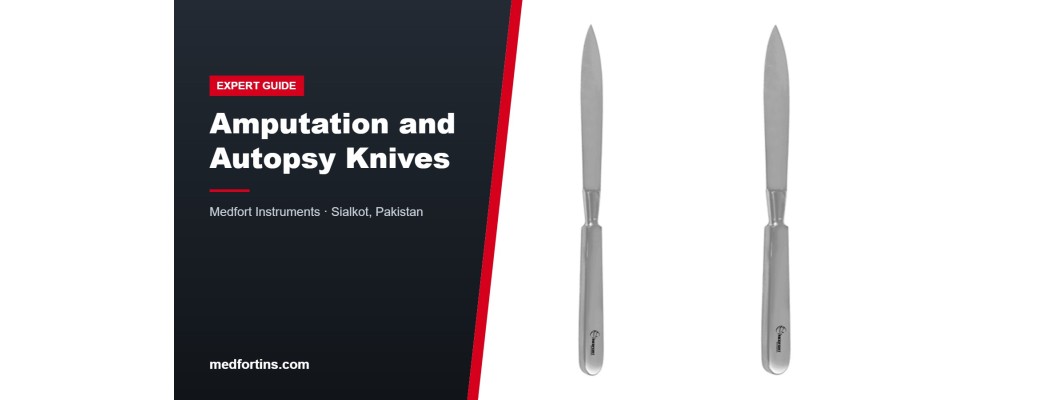
Amputation and post-mortem knives are long, strong blades made for cutting through large volumes of soft tissue in a single, controlled stroke. Classic patterns such as Liston, Catlin and Langenbeck are still used today in orthopedic surgery, pathology and teaching.
Where amputation and autopsy (postmortem) knives are used
They are used in limb amputation, autopsy and pathology work, and in anatomy departments. Phalangeal and interosseous knives are smaller patterns for fingers, toes and the spaces between bones.
What is in the Medfort range
The amputation and autopsy (postmortem) knives category currently lists 19 items. Popular patterns include:
- Liston Amputation Knife
- Catlin Amputation Knife
- Langenbeck Flap Knife
- Phalangeal Knife
- Interosseous Knife
- Resection Knife
- Langenbeck Resection Knife
- Virchow Autopsy Knife
Most patterns come in several lengths and tip styles. You can see every size on the Amputation and Autopsy (Postmortem) Knives page, and we can make other sizes to order.
How to choose the right amputation and autopsy (postmortem) knives
Choose the blade length and shape to suit the limb or task: long Liston blades for large limbs, double-edged Catlin knives for cutting between bones, and smaller patterns for digits. A solid, non-slip handle is essential.
Whatever pattern you choose, ask the supplier which steel grade and standard is used, check the finish and the joint or spring action on a sample, and make sure spare parts, repairs and resharpening are available.
Material and quality
A scissor is only as good as its edge. Look for blades hardened and hand-honed from surgical grade stainless steel, closing smoothly from the joint to the tip with no catching. Many patterns are also available as SuperCut, with one razor-sharp blade and one micro-serrated blade that stops tissue slipping, or with tungsten carbide (TC) inserts and gold handles, which stay sharp for much longer.
Every pair is test-cut before packing. We check the edge along its whole length, the alignment of the tips and the feel of the joint, then passivate and pack the scissors with tip protection.
Care and sterilization tips
- Clean scissors straight after use, with the blades fully open.
- Never use them to cut wire, paper or dressings unless they are made for it.
- Keep the tips apart from heavy instruments in trays.
- Lubricate the joint after cleaning.
- Send them for resharpening as soon as the cut feels rough; a good pair can be resharpened many times.
Frequently asked questions
Can amputation knives be resharpened?
Yes. These are solid stainless steel blades and can be resharpened many times by a cutler.
Can blunt scissors be resharpened?
Yes. Medfort scissors can be resharpened and realigned, and TC insert scissors can be reground several times before the inserts need replacing.
Do you supply hospitals and distributors abroad?
Yes. We ship worldwide and supply hospitals, clinics, distributors and tender buyers, with single instruments, bulk quantities or complete sets.
Related categories
You may also be interested in: General Surgical Instruments, Surgical Scissors, Bulldog Clamps, Dissecting and Ligature Forceps, Hemostatic Forceps, Hysterectomy Forceps.
Talk to Medfort
Medfort Instruments manufactures in Sialkot, Pakistan, and supplies hospitals, clinics, distributors and tender buyers around the world. We make single instruments, bulk orders, complete sets and OEM or private-label ranges with your own laser marking. For prices, samples or a quote, email [email protected] or call / WhatsApp +92 349 0444976.