
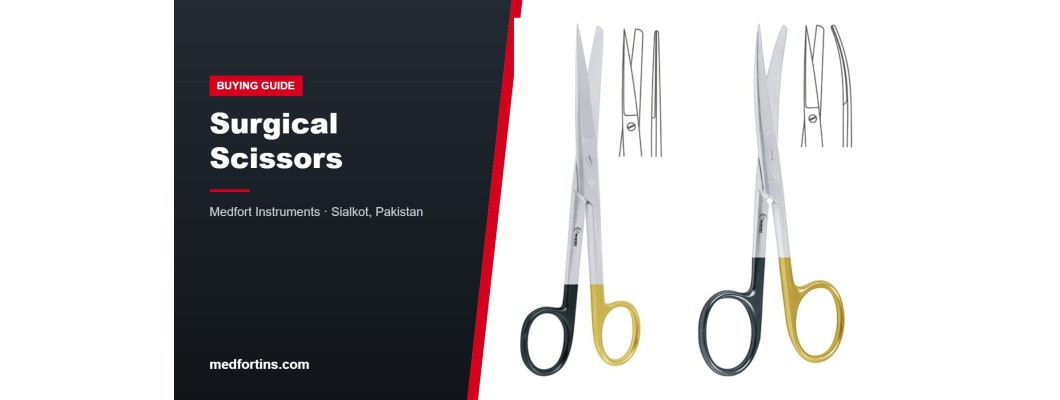
Surgical scissors are among the most used instruments in any theatre, and among the first to wear out when they are poorly made. From heavy operating scissors for sutures and dressings to fine tenotomy and micro patterns for delicate tissue, choosing the right pattern, edge and length makes surgery faster and safer. This guide walks through the main types we manufacture.
Where surgical scissors are used
Surgical scissors are used in every specialty: dissecting and cutting tissue, cutting sutures and dressings, opening vessels, and working in deep or narrow cavities. Each specialty favours its own patterns, lengths and blade shapes.
What is in the Medfort range
Our surgical scissors are grouped into these ranges, each with its own guide and product list:
- Tungsten Carbide Supercut Scissors
- Operating Scissors
- Iris Scissors
- Tungsten Carbide Scissors UltraCut
- Tenotomy Scissors
- SuperEdge SuperCut Scissors
Most patterns come in several lengths and tip styles. You can see every size on the Surgical Scissors page, and we can make other sizes to order.
How to choose the right surgical scissors
Start with the job. Use operating scissors for sutures and dressings, dissecting scissors such as Mayo and Metzenbaum for tissue, and fine or micro patterns for delicate work. Choose curved blades for better visibility and straight blades for precise cutting on the surface. For long lists, consider SuperCut or tungsten carbide edges.
Whatever pattern you choose, ask the supplier which steel grade and standard is used, check the finish and the joint or spring action on a sample, and make sure spare parts, repairs and resharpening are available.
Material and quality
A scissor is only as good as its edge. Look for blades hardened and hand-honed from surgical grade stainless steel, closing smoothly from the joint to the tip with no catching. Many patterns are also available as SuperCut, with one razor-sharp blade and one micro-serrated blade that stops tissue slipping, or with tungsten carbide (TC) inserts and gold handles, which stay sharp for much longer.
Every pair is test-cut before packing. We check the edge along its whole length, the alignment of the tips and the feel of the joint, then passivate and pack the scissors with tip protection.
Care and sterilization tips
- Clean scissors straight after use, with the blades fully open.
- Never use them to cut wire, paper or dressings unless they are made for it.
- Keep the tips apart from heavy instruments in trays.
- Lubricate the joint after cleaning.
- Send them for resharpening as soon as the cut feels rough; a good pair can be resharpened many times.
Frequently asked questions
What is the difference between Mayo and Metzenbaum scissors?
Mayo scissors are heavier, with shorter, thicker blades for tough tissue and sutures. Metzenbaum scissors are longer and finer, with a long handle-to-blade ratio for delicate dissection.
Can blunt scissors be resharpened?
Yes. Medfort scissors can be resharpened and realigned, and TC insert scissors can be reground several times before the inserts need replacing.
Do you supply hospitals and distributors abroad?
Yes. We ship worldwide and supply hospitals, clinics, distributors and tender buyers, with single instruments, bulk quantities or complete sets.
Related categories
You may also be interested in: General Surgical Instruments, Bulldog Clamps, Dissecting and Ligature Forceps, Hemostatic Forceps, Hysterectomy Forceps, Kidney Pedicle Clamps.
Talk to Medfort
Medfort Instruments manufactures in Sialkot, Pakistan, and supplies hospitals, clinics, distributors and tender buyers around the world. We make single instruments, bulk orders, complete sets and OEM or private-label ranges with your own laser marking. For prices, samples or a quote, email [email protected] or call / WhatsApp +92 349 0444976.