
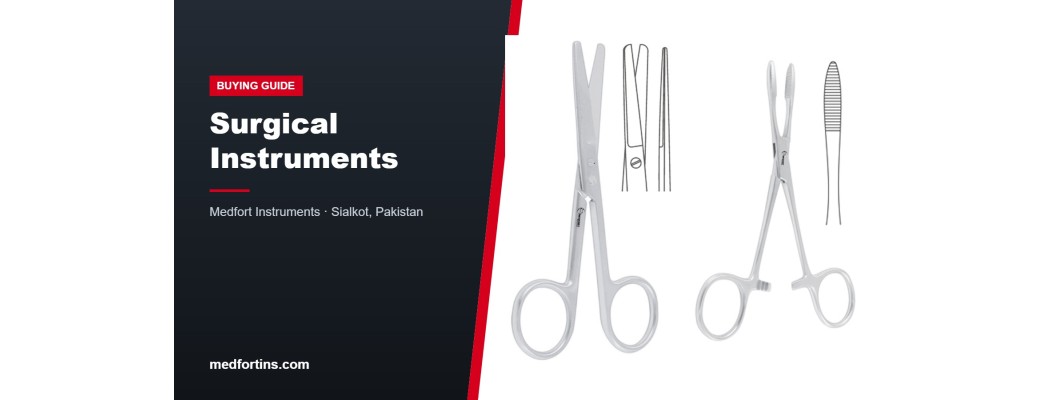
Reusable surgical instruments are one of the longest-lasting investments a hospital makes. A good pair of scissors or a well-made needle holder can stay in service for many years, while a poor one can blunt, stiffen or corrode within months. This guide explains what to look for when you buy surgical instruments, whether you equip a single theatre or supply hospitals as a distributor.
Start with the procedures, not the catalogue
The easiest way to buy the wrong instruments is to start from a long catalogue. Start instead from the operations your team performs. List the procedures, then the instruments each one needs, then how many sets you must run in parallel to cover your theatre schedule and sterilization turnaround. This gives you a realistic quantity for each pattern and avoids shelves of instruments that are never used.
Most departments find that a small number of patterns do most of the work: dissecting scissors, tissue and dressing forceps, haemostatic forceps, needle holders, retractors and towel clamps. Buy these in depth, and add specialist instruments as your procedures require.
Material: surgical grade stainless steel
Medfort instruments are made from surgical grade stainless steel to AISI, ASTM and DIN standards. Cutting and gripping instruments use hardenable martensitic steels, which can be heat-treated to hold an edge or a firm grip. The heat treatment matters as much as the steel: too soft and edges roll over, too hard and the instrument can crack. Every Medfort instrument is hardness-checked after heat treatment.
After finishing, instruments are passivated. Passivation strengthens the thin chromium oxide layer that protects stainless steel from corrosion. An instrument that has not been properly passivated can show rust spots after only a few cycles in the autoclave.
Satin, mirror or coloured finishes
A satin (matte) finish reduces glare under bright theatre lights and is the most popular choice for general instruments. A mirror finish is easy to clean and looks bright, and is common on holloware. Some ranges use coloured or gold handles as a code: gold ring handles usually mean tungsten carbide (TC) inserts, and black handles often mark SuperCut scissors. These codes help theatre staff pick the right instrument quickly.
Tungsten carbide and SuperCut options
Tungsten carbide inserts are much harder than stainless steel. On needle holders they grip the needle firmly without slipping; on scissors they keep a sharp edge far longer. They cost more at first but usually cost less over the life of the instrument. SuperCut scissors have one razor-sharp blade for a clean, smooth cut with less tissue trauma, and are popular in plastic, vascular and general surgery.
How to judge quality when samples arrive
- Joints and box locks: open and close the instrument. The movement should be smooth with no grinding, and there should be no side-to-side play.
- Ratchets: each tooth should engage clearly and release with light pressure. A ratchet that slips or sticks is a safety problem.
- Jaws and tips: hold the instrument up to the light. Jaws should meet evenly along their length, and tips should align exactly.
- Scissors: cut a piece of thin latex or gauze. The cut should be clean from the joint to the tip without catching.
- Surface: look for pits, cracks, burrs and uneven polishing, especially in serrations where dirt can hide.
Plan for care and sterilization
Even the best instrument fails early if it is not cared for. Rinse instruments straight after use so blood does not dry on, open all joints for cleaning, use neutral pH detergents, dry thoroughly and lubricate hinges with instrument milk before steam sterilization. Inspect instruments regularly and send scissors and cutting instruments for sharpening before they start to tear tissue. A simple care routine adds years to every set.
Sets, trays and traceability
Many hospitals now buy complete procedure sets rather than loose instruments. Sets make counting easier, reduce missing items and simplify sterilization. Laser marking can add your hospital name, set code or a unique number to each instrument for traceability. Medfort can supply sets loose, on trays or in stainless steel boxes, built to your own list.
Where Medfort fits
Our range covers every main specialty: general surgical instruments, orthopedic instruments, ENT instruments, plastic surgery instruments, gynecology, neurosurgery, electrosurgical instruments and hospital holloware. Browse all of them in our surgical instruments section.
Quick checklist
- List your procedures and the instruments each one needs.
- Decide quantities based on theatre schedules and sterilization time.
- Choose finishes and options (TC, SuperCut) for the instruments used most.
- Order samples and check joints, ratchets, tips and cutting.
- Agree a care and repair routine with your sterile services team.
Talk to Medfort
Medfort Instruments manufactures in Sialkot, Pakistan, and supplies hospitals, clinics, distributors and tender buyers around the world. We make single instruments, bulk orders, complete sets and OEM or private-label ranges with your own laser marking. For prices, samples or a quote, email [email protected] or call / WhatsApp +92 349 0444976.