
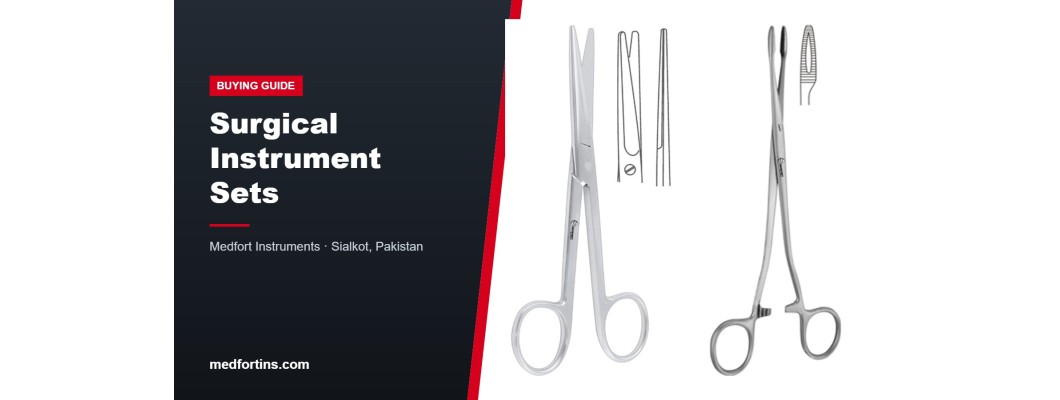
Hospitals can buy surgical instruments one by one, or as complete procedure sets. For most theatres, clinics and health programmes, complete sets are the better choice. They make it easier to prepare for surgery, count instruments, sterilize, and replace what is missing. This guide explains how instrument sets work and how to choose the right ones for your facility.
What is an instrument set?
An instrument set is a defined list of instruments, in fixed quantities, for one type of procedure. A caesarean section set, for example, contains the scissors, forceps, clamps, retractors and needle holders a team needs to perform a caesarean, and nothing else. Every set of the same type is identical, so staff always know what should be on the tray.
Why sets work better than loose instruments
- Faster preparation: the sterile services team prepares one complete set instead of picking instruments individually.
- Safer counting: a fixed list makes it easier to count instruments before and after surgery and to notice if one is missing.
- Simpler sterilization: sets are processed and stored as one unit, in a box or wrapped tray.
- Easier budgeting: you know the cost of equipping each theatre or clinic.
- Standard training: staff learn one layout and find instruments quickly, even in emergencies.
Common sets
Medfort supplies a wide range of sets, including:
- Maternity: delivery sets, caesarean section sets, and dilation and curettage (D&C) sets.
- General surgery: small, medium and major surgery sets, laparotomy sets, appendectomy sets, gallbladder and bile duct sets, and amputation sets.
- Gynecology: gynecology examination sets, basic vaginal sets, hysterectomy sets and IUD sets.
- Ward and clinic: dressing sets, enema sets and diagnostic equipment sets for outpatient departments, wards and mother-and-child health clinics.
- Specialty: orthopaedic, ENT, dental, kidney and bladder sets, and intubation sets.
Standard lists or your own list
Many health programmes and NGOs use standard set lists so that every facility receives the same equipment. Hospitals often prefer their own lists, adjusted to their surgeons' preferences. We can build sets either way: send us your list with patterns, sizes and quantities, and we will quote for the complete set.
How sets are packed
Sets can be supplied loose and bagged, on perforated trays, or in stainless steel instrument boxes. Boxes protect instruments during storage and transport and can go straight into the autoclave. For programmes that ship to remote facilities, sturdy packing and clear labels make receiving and checking sets much easier.
Choosing quantities
The number of sets you need depends on how many procedures you perform each day and how long sterilization takes. If a theatre performs four caesareans a day and processing takes several hours, one set is not enough: you need enough sets to cover the operations that happen while others are being cleaned and sterilized, plus a spare. Planning this in advance avoids delays and the temptation to rush sterilization.
Keeping sets complete
Sets only work if they stay complete. Keep a printed list with every set, check it after each use, and replace lost or damaged instruments promptly. Laser marking with a set code or facility name helps return stray instruments to the right set. When an instrument becomes worn, replace it with the same pattern so the set stays standard.
Quality matters in every piece
A set is only as good as its weakest instrument. A needle holder that slips or a clamp whose ratchet does not hold can stop an operation. Every Medfort instrument is checked for alignment, smooth joints and secure ratchets before it is packed into a set.
Browse all available sets in instrument sets, or send us your own list for a quote.
Talk to Medfort
Medfort Instruments manufactures in Sialkot, Pakistan, and supplies hospitals, clinics, distributors and tender buyers around the world. We make single instruments, bulk orders, complete sets and OEM or private-label ranges with your own laser marking. For prices, samples or a quote, email [email protected] or call / WhatsApp +92 349 0444976.