
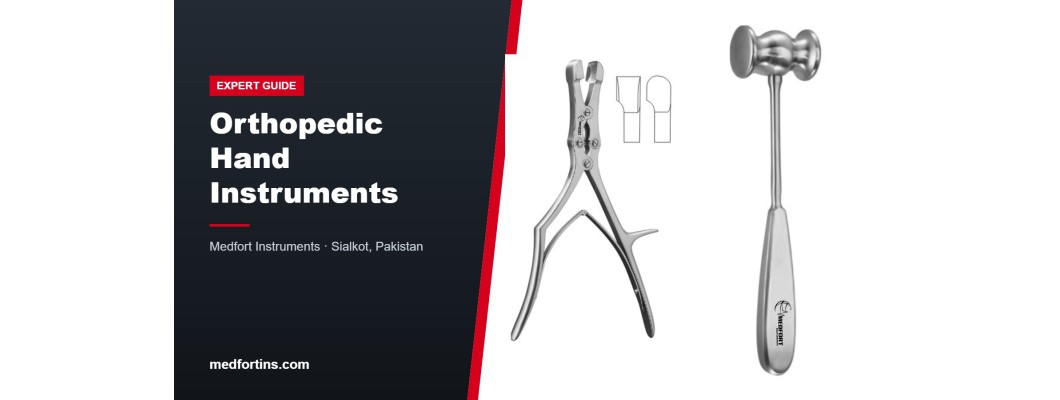
Orthopedic surgery asks a lot of its instruments. They must cut and shape bone, hold heavy fragments steady, and withstand strong forces again and again without bending, blunting or loosening. Even in theatres that use powered drills and saws, hand instruments do much of the work. This guide explains the main groups of orthopedic hand instruments and what to look for in each.
Cutting bone
Bone cutting forceps cut ribs, small bones and fragments. Compound-action patterns multiply the force of the hand, so they cut dense bone with less effort. Rongeurs have cupped jaws that nibble away small pieces of bone, to trim edges or remove bone in spinal surgery. Kerrison-type bone punches remove bone precisely near nerves. Amputation saws and Gigli wire saws cut through long bones without power.
Chisels, osteotomes and mallets
A chisel has a single bevel and cuts or shaves bone, while an osteotome has a double bevel and cuts straight through. Both are driven with a mallet. Choose blade widths to suit the bone and the cut, and match the weight of the mallet to the instrument: heavier mallets for large osteotomes, lighter ones for fine work. Gouges remove curved sections of bone, and bone rasps and files smooth edges after cutting.
Exposing and lifting bone
Periosteal elevators lift the periosteum so bone can be exposed. Bone levers, especially Hohmann-type levers, hook around the bone to lift it and hold soft tissue away, protecting muscles, nerves and vessels. Knee and joint retractors give access in joint surgery. Most sets carry several widths so the lever can be matched to the bone.
Holding and reducing fractures
Bone holding forceps, including self-centering and Lane patterns, grip bone firmly while plates and screws are applied. Reduction (repositioning) forceps with pointed tips bring fracture fragments back into line, and their ratchet holds the reduction steady. Bone holding clamps grip long bones during reduction and fixation.
Wires, pins and fixation
Wire work needs its own instruments: wire cutting forceps rated for the hardness and diameter of the wire, wire twisting and holding forceps for cerclage and tension band wiring, and flat-nose pliers for bending. Tungsten carbide (TC) jaws grip and cut wire more reliably and last far longer. Hand drills, reamers and twist drills prepare holes, and Kirschner wire traction bows are used for skeletal traction. Stainless steel bone screws and plates complete the fixation set.
What to look for
- Hardness: cutting edges must be hard enough to stay sharp, but not so brittle that they chip.
- Strength: joints and springs must stay tight and smooth under heavy force.
- Alignment: rongeur and cutter jaws must meet evenly so they cut cleanly.
- Grip: handles should give a secure, comfortable hold, even with wet gloves.
Sharpening and repair
Cutting instruments such as osteotomes, chisels, rongeurs and cutters lose their edge with use. A blunt instrument needs more force, gives a less precise cut, and can slip. Plan regular sharpening and keep a spare of your most-used patterns, so one can be sent for service while the other stays in use.
Care
Bone fragments and tissue collect in jaws, teeth and joints, so clean orthopedic instruments immediately after use. Open all joints, brush the jaws and teeth, rinse, dry and lubricate moving parts before steam sterilization. Check cutting edges and springs regularly, and remove damaged instruments from service.
Building orthopedic sets
A basic orthopedic set usually includes periosteal elevators, Hohmann levers, bone holding and reduction forceps, a rongeur, bone cutting forceps, osteotomes and a mallet, a rasp, and wire instruments. Trauma, spine and joint sets add specialist instruments. Tell us your procedures and we will help you put sets together.
Browse the complete range in orthopedic instruments.
Talk to Medfort
Medfort Instruments manufactures in Sialkot, Pakistan, and supplies hospitals, clinics, distributors and tender buyers around the world. We make single instruments, bulk orders, complete sets and OEM or private-label ranges with your own laser marking. For prices, samples or a quote, email [email protected] or call / WhatsApp +92 349 0444976.