
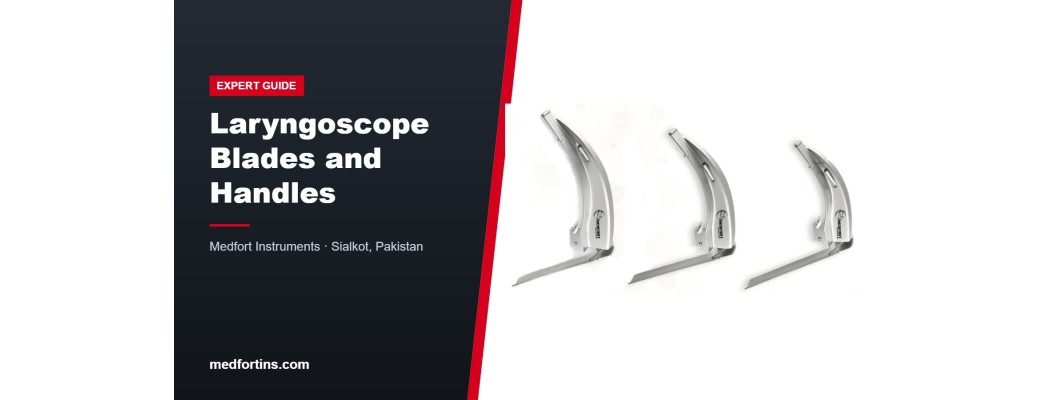
The laryngoscope is one of the most important instruments in any hospital. It is used every day in operating theatres for intubation, and it must work perfectly in emergencies, when there is no time to search for a working blade or a fresh battery. This guide explains the main choices you face when you buy reusable laryngoscopes, and how to keep them ready for use.
How a laryngoscope works
A laryngoscope has two parts: a handle and a blade. The handle holds the batteries and, in fiber optic systems, the light source. The blade is inserted into the mouth to lift the tongue and soft tissue so the clinician can see the vocal cords and pass an endotracheal tube. Blades click onto the handle with a hook-on fitting, and the light switches on when the blade is opened into its working position.
Curved or straight blades
Macintosh blades are curved. The tip sits in the space in front of the epiglottis and lifts it indirectly. They are the most widely used blades for adults and give good room to pass the tube.
Miller blades are straight. The tip lifts the epiglottis directly. Many clinicians prefer them for infants and small children, and for patients whose larynx is high or difficult to see with a curved blade.
Both patterns come in a range of sizes, from small sizes for neonates up to large adult sizes. A complete airway kit usually includes several sizes of each, so the right blade is always at hand.
Conventional or fiber optic
In a conventional laryngoscope, a small bulb sits near the tip of the blade. It is simple and economical, but the bulb can loosen or fail, and the bulb area needs careful cleaning.
In a fiber optic laryngoscope, the light source sits in the handle and a sealed bundle of glass fibers carries the light down the blade. There is no bulb in the blade, so there is nothing to loosen, and the blade is easier to clean and sterilize. Fiber optic systems usually give brighter, whiter light.
Medfort supplies both, including fiber optic blades for the green system, the widely used colour-coded standard for fiber optic blades and handles. Green-coded blades and handles are designed to work together, so it is important not to mix fiber optic and conventional parts.
Choosing handles
Handles come in different sizes, from slim handles for paediatric use to standard adult handles. Check that the handle matches your blades (conventional or fiber optic) and the battery type you can easily source. Many departments keep at least one spare handle and fresh batteries in each airway trolley.
Special blades
Beyond the standard Macintosh and Miller patterns, special blades are made for particular airway needs and clinician preferences. If your team uses a specific pattern, tell us the name and size and we will confirm availability.
Daily checks
- Attach each blade and open it: the light should come on immediately and be bright and steady.
- Check that the blade locks firmly and does not wobble on the handle.
- Look for cracks, sharp edges or damage on the blade, especially near the tip.
- Replace weak batteries before they fail, not after.
Cleaning and sterilization
Always remove the batteries before cleaning the handle. Blades can be washed and steam sterilized; wipe and disinfect handles according to your hospital policy and the instructions supplied. Never use abrasive pads on the light window or fiber optic end, as scratches reduce the light. Store blades and handles separately or with the blade closed, so the light does not switch on and drain the battery.
Building an airway kit
A practical adult kit might include Macintosh blades in several sizes, at least one Miller blade, two handles and spare batteries. A paediatric kit adds small Miller and Macintosh blades and a slim handle. Keeping identical kits in theatre, recovery, the emergency department and intensive care means staff always find the same layout under pressure.
Why reusable
Reusable stainless steel laryngoscopes give a reliable feel and long service life, and can be cleaned and sterilized many times. With the right care routine, a good set will serve your department for years.
See our full range in diagnostic instruments, including conventional laryngoscopes, fiber optic green system blades and special blades.
Talk to Medfort
Medfort Instruments manufactures in Sialkot, Pakistan, and supplies hospitals, clinics, distributors and tender buyers around the world. We make single instruments, bulk orders, complete sets and OEM or private-label ranges with your own laser marking. For prices, samples or a quote, email [email protected] or call / WhatsApp +92 349 0444976.