
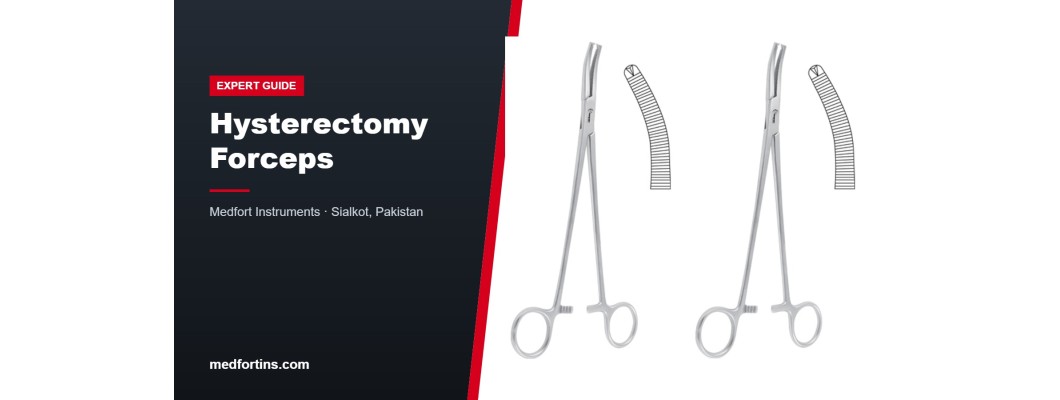
Hysterectomy forceps are strong clamping forceps designed to hold and compress tissue pedicles during hysterectomy. Patterns such as Wertheim, Moynihan, Heaney and Berkeley-Bonney have long jaws with deep serrations or longitudinal grooves so tissue does not slip.
Where hysterectomy forceps are used
They are used in abdominal and vaginal hysterectomy and other gynecological procedures, to clamp the uterine vessels, ligaments and vaginal cuff before cutting and ligating.
What is in the Medfort range
The hysterectomy forceps category currently lists 29 items. Popular patterns include:
- Wertheim Hysterectomy Forcep
- Moynihan Hysterectomy Forcep
- Burke Hysterectomy Forcep
- Kieback Hysterectomy Forcep
- Berkeley-Bonney Hysterectomy Forcep
- Gwilliam Hysterectomy Forcep
- Holzbach Hysterectomy Forcep
- Kocher (Delicate) Haemostatic Forceps
Most patterns come in several lengths and tip styles. You can see every size on the Hysterectomy Forceps page, and we can make other sizes to order.
How to choose the right hysterectomy forceps
Choose curved or straight jaws to suit the approach, and the jaw pattern for the tissue: longitudinal serrations for a secure grip and atraumatic patterns for delicate tissue. Make sure the length reaches comfortably into the pelvis.
Whatever pattern you choose, ask the supplier which steel grade and standard is used, check the finish and the joint or spring action on a sample, and make sure spare parts, repairs and resharpening are available.
Material and quality
Look for instruments forged from surgical grade stainless steel that meets AISI, ASTM or DIN standards. Good steel holds its shape after thousands of autoclave cycles, and correct heat treatment keeps jaws and serrations from wearing smooth. A satin (matte) finish is worth asking for, because it cuts glare under bright theatre lights and hides small scratches better than a mirror polish.
Before packing, each Medfort instrument is checked for hardness, jaw alignment, ratchet action and surface finish, then passivated to improve its resistance to corrosion.
Care and sterilization tips
- Rinse off blood and tissue before it dries.
- Open every joint and ratchet before washing or ultrasonic cleaning.
- Use a neutral pH detergent, never bleach or saline for soaking.
- Dry completely and apply instrument milk to hinges.
- Steam sterilize with joints open, and set aside any instrument that is stiff, cracked or out of line.
Frequently asked questions
Why do hysterectomy forceps have such strong ratchets?
The forceps must hold thick tissue pedicles firmly until they are ligated, so the jaws and ratchet are made stronger than standard hemostatic forceps.
Can I order a size that is not listed?
Yes. Send us a drawing, a sample or a catalogue number and we will quote for it. We also make OEM and private label instruments with your logo laser-etched on them.
Do you supply hospitals and distributors abroad?
Yes. We ship worldwide and supply hospitals, clinics, distributors and tender buyers, with single instruments, bulk quantities or complete sets.
Related categories
You may also be interested in: General Surgical Instruments, Surgical Scissors, Bulldog Clamps, Dissecting and Ligature Forceps, Hemostatic Forceps, Kidney Pedicle Clamps.
Talk to Medfort
Medfort Instruments manufactures in Sialkot, Pakistan, and supplies hospitals, clinics, distributors and tender buyers around the world. We make single instruments, bulk orders, complete sets and OEM or private-label ranges with your own laser marking. For prices, samples or a quote, email [email protected] or call / WhatsApp +92 349 0444976.