
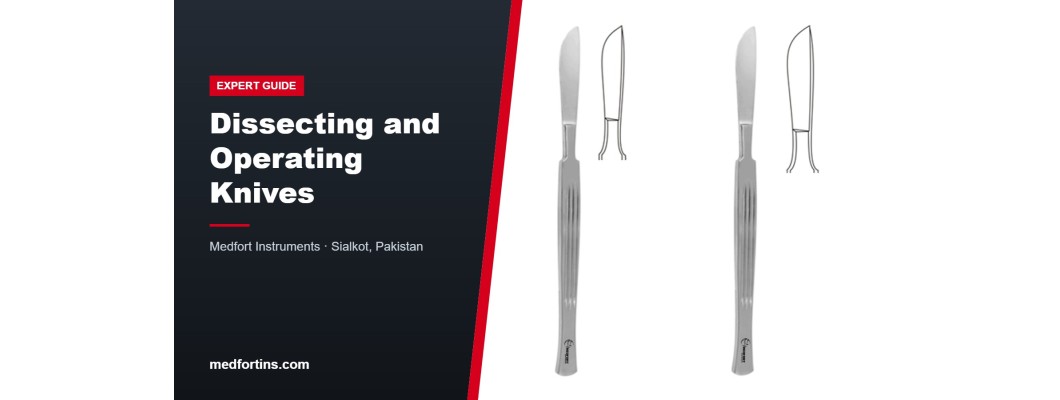
Solid dissecting and operating knives are one-piece instruments with the blade and handle made from a single piece of stainless steel. Unlike disposable scalpel blades, they can be resharpened and sterilized many times, which makes them popular for teaching, pathology and some surgical uses.
Where dissecting and operating knives are used
They are used in anatomy and pathology departments, veterinary practice and some surgical procedures where a rigid, reusable blade is preferred.
What is in the Medfort range
The dissecting and operating knives category currently lists 13 items. Popular patterns include:
Most patterns come in several lengths and tip styles. You can see every size on the Dissecting and Operating Knives page, and we can make other sizes to order.
How to choose the right dissecting and operating knives
Choose the blade shape (pointed, rounded or bellied) and the length to suit the cutting task. Check the handle for a secure grip and the edge for even sharpness along its length.
Whatever pattern you choose, ask the supplier which steel grade and standard is used, check the finish and the joint or spring action on a sample, and make sure spare parts, repairs and resharpening are available.
Material and quality
A scissor is only as good as its edge. Look for blades hardened and hand-honed from surgical grade stainless steel, closing smoothly from the joint to the tip with no catching. Many patterns are also available as SuperCut, with one razor-sharp blade and one micro-serrated blade that stops tissue slipping, or with tungsten carbide (TC) inserts and gold handles, which stay sharp for much longer.
Every pair is test-cut before packing. We check the edge along its whole length, the alignment of the tips and the feel of the joint, then passivate and pack the scissors with tip protection.
Care and sterilization tips
- Clean scissors straight after use, with the blades fully open.
- Never use them to cut wire, paper or dressings unless they are made for it.
- Keep the tips apart from heavy instruments in trays.
- Lubricate the joint after cleaning.
- Send them for resharpening as soon as the cut feels rough; a good pair can be resharpened many times.
Frequently asked questions
Why use a solid knife instead of a scalpel?
A solid knife is more rigid, can be resharpened and does not produce blade waste, which suits teaching labs and pathology work.
Can blunt scissors be resharpened?
Yes. Medfort scissors can be resharpened and realigned, and TC insert scissors can be reground several times before the inserts need replacing.
Do you supply hospitals and distributors abroad?
Yes. We ship worldwide and supply hospitals, clinics, distributors and tender buyers, with single instruments, bulk quantities or complete sets.
Related categories
You may also be interested in: General Surgical Instruments, Surgical Scissors, Bulldog Clamps, Dissecting and Ligature Forceps, Hemostatic Forceps, Hysterectomy Forceps.
Talk to Medfort
Medfort Instruments manufactures in Sialkot, Pakistan, and supplies hospitals, clinics, distributors and tender buyers around the world. We make single instruments, bulk orders, complete sets and OEM or private-label ranges with your own laser marking. For prices, samples or a quote, email [email protected] or call / WhatsApp +92 349 0444976.